The Gulf · The war in IranLate wire

U.S. warns Gulf of a ‘short, intense’ return to war in Iran

Washington has told Gulf allies to prepare for a fresh offensive after next week’s midterm elections, as Qatari mediators carry a new draft to Tehran and the eight-month war’s bill reaches $47.1bn.
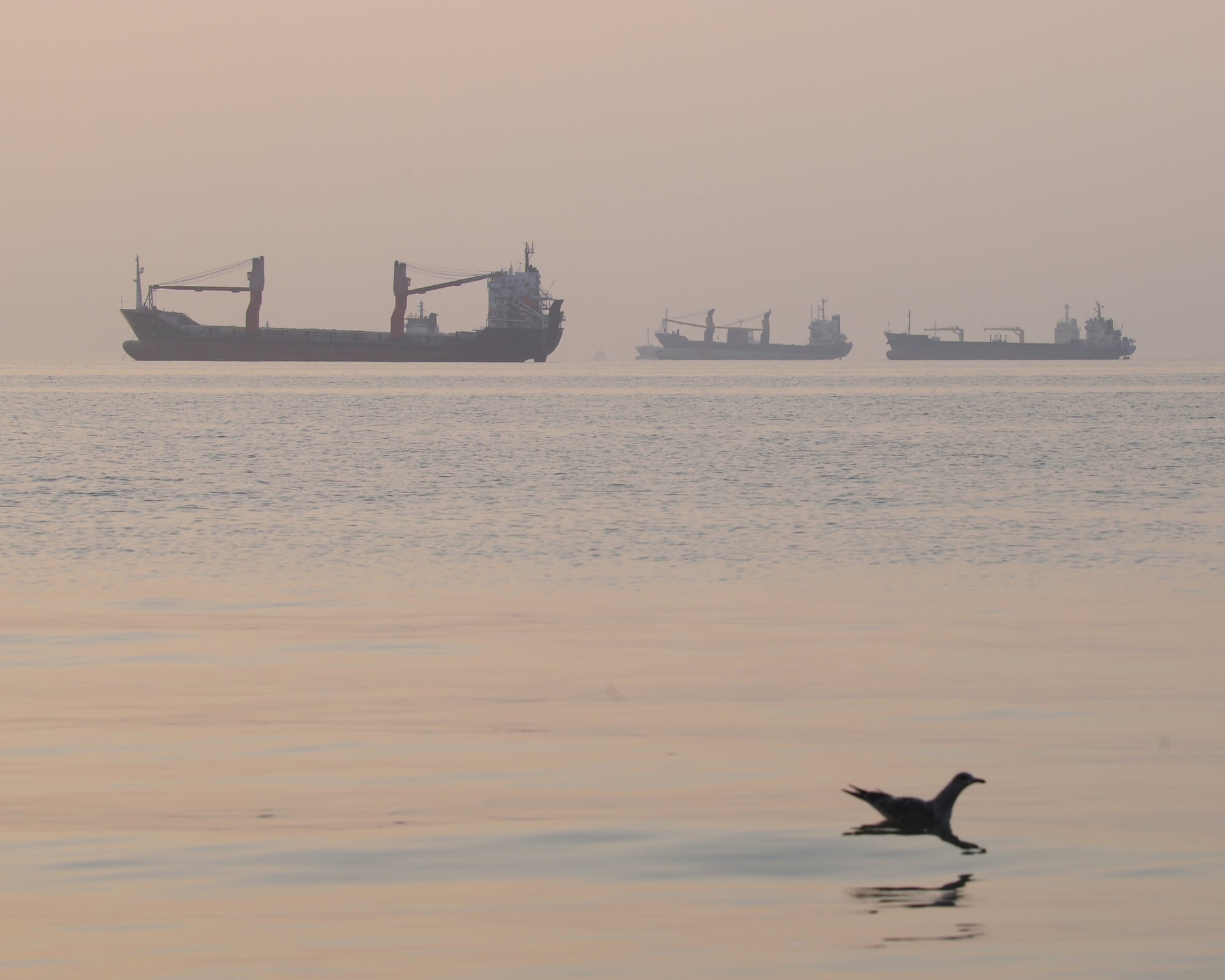
Cargo ships at anchor in the Strait of Hormuz, seen from a hazy shore, with a seabird flying low over the water.
Cargo ships at anchor in the Strait of Hormuz off Bandar Abbas. At least 15 vessels have been struck in the waterway in the past ten days. Photograph: Amirhosein Khorgooi / AP

The United States has warned Gulf states to prepare for a possible “short, intense” renewal of its war with Iran after next week’s midterm elections, according to The Wall Street Journal, even as Qatari mediators carried a new draft ceasefire to Tehran.

An Iranian official said the ideas presented in the latest mediation were “unacceptable”, telling Reuters that the proposals fell short of Tehran’s demand for guaranteed sanctions relief. Qatar’s mediators said a fresh text had been put forward.

The Pentagon told Congress on Wednesday that the eight-month war had cost $47.1bn, more than 25 per cent more than in July. It has reported 21 American service members killed and more than 800 wounded; this week it lowered its casualty count, prompting questions from lawmakers.

Oil rose above $117 a barrel last week after Iran threatened to strike refineries, data centres and undersea cables across the Gulf if the United States or Israel attacked again. At least 15 vessels have been struck in the Strait of Hormuz in the past ten days, and two container ships sank this month.

Gulf states are trying to assemble a wider settlement: sanctions relief for Iran, the reopening of the strait within four days of sanctions being lifted, the withdrawal of Houthi forces in Yemen and a regional security pact that would reduce the American military presence. European diplomats say a deal also requires Iran to readmit UN weapons inspectors. Tehran has refused.

“Recently, there has been talk of a new war, but I am already thinking about the postwar period,” Iran’s foreign minister, Abbas Araghchi, said this week. “Whether there is war or not, our policies remain the same.”
Gaza & the Levant · One year of ‘ceasefire’The toll

A truce that still buries the dead

Gaza’s health ministry says 74,564 people have been killed since October 2023 — including 1,565 since the ceasefire began. With food aid cut and bakeries shuttered, 1.4 million people face acute hunger.

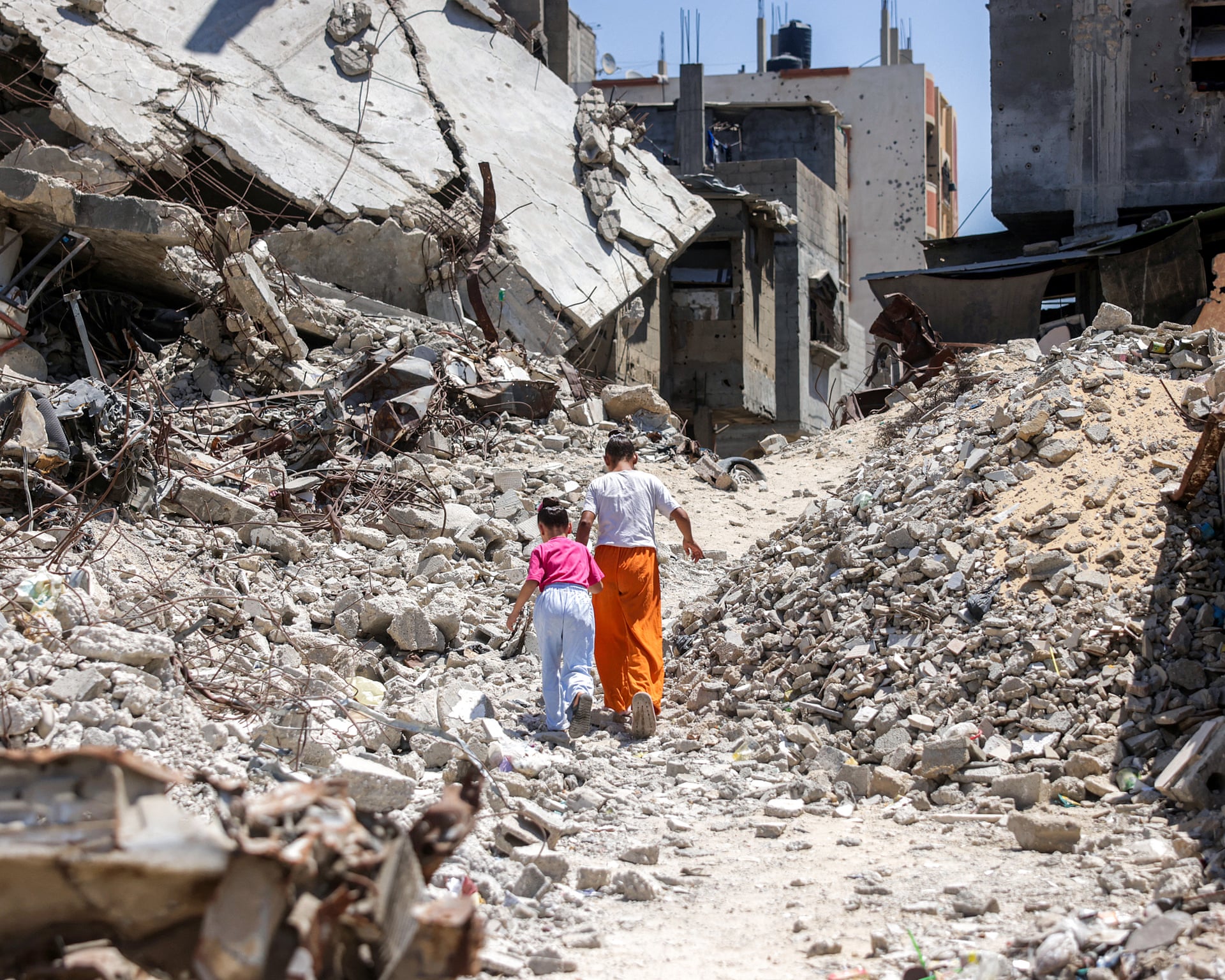
Two girls walk through a landscape of collapsed concrete and rubble in Gaza under a blue sky.
Two girls walk past collapsed buildings in Khan Younis, southern Gaza, on 25 August 2026. Photograph: Bashar Taleb / AFP / Getty Images

The dead are still being counted. Gaza’s health ministry said on Wednesday that 74,564 Palestinians had been killed since the war began in October 2023, including 1,565 since the US-brokered ceasefire took effect a year ago. More than 175,000 have been wounded.

The UN’s independent commission of inquiry concluded this week that Israel had continued to commit genocide in Gaza after the truce, citing the scale of the killings, the destruction of hospitals and the restriction of aid. Israel has rejected previous genocide findings and says its operations target Hamas.

Aid agencies warn that hunger is rising again. The World Food Programme is ending support for half a million Palestinians because of funding cuts; at least ten bakeries have closed for lack of flour; 1.4 million people are facing acute hunger, according to local health officials. Families describe empty markets and prices they cannot meet.

Israel’s election has done little to change the calculation. Both Netanyahu and Gadi Eisenkot have vowed to end Hamas rule, but neither has offered a plan for reconstruction or a political horizon. In the occupied West Bank, Israeli forces have displaced nearly 2,000 Palestinians in Hebron in recent days.

Killed since Oct. 202374,564
Wounded175,000+
Killed since the truce1,565
Facing acute hunger1.4m

“We are now strangers even to ourselves.”

Akram al-Sourani, writing from Gaza one year after the ceasefire
Sources: Gaza Ministry of Health; UN; WFP; The Guardian; Reuters; BBC · 28 Oct. 2026 Read the essay
Ukraine & the Black Sea · Day 1,708The corridor

In a city that ate weeds, a fragile quiet

Russia and Ukraine have extended a local truce across southern Kherson, allowing aid into Oleshky for the first time in years. Both sides call it the largest de-escalation since 2022. The wider war has not paused.

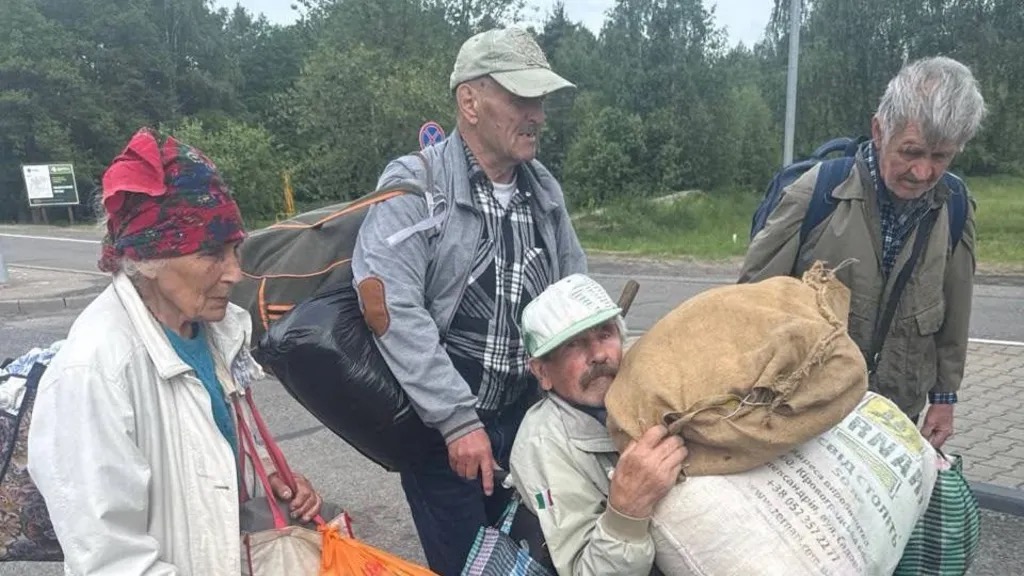
Four elderly residents carrying sacks and bags after leaving Oleshky, standing beside a road.
Residents who left Oleshky in spring 2026 carry their belongings. An estimated 1,700–2,000 people remain trapped in the city. Photograph: Ksenia Arkhipova / BBC

A ceasefire that began as a humanitarian corridor for the Russian-occupied city of Oleshky has been extended across the wider Kherson region, Ukrainian and Russian officials said, as both sides reported no breaches in the first two days.

The truce, brokered with the help of the US first lady, Melania Trump, and Pope Leo XIV, is due to last until 22:59 Ukrainian time on Sunday. It is meant to allow demining and food and medical convoys into Oleshky, followed by the evacuation of civilians on Friday. Some 1,700–2,000 people remain in the city; residents have described eating garden weeds to survive.

Oleshky has had no electricity, gas or water since the Kakhovka dam was destroyed in 2023. The city sits on the Russian-held south bank of the Dnipro; escape routes are mined and exposed to drones. One woman told the BBC she had stepped on a landmine and had undergone two operations. About 500 people had expressed interest in leaving by Tuesday afternoon.

Beyond Kherson, the war continues. Russian missiles struck Kyiv hours before the truce began. President Volodymyr Zelensky said Ukrainian forces were retaking territory and described the battlefield position as the strongest in some time. The Kremlin said European countries would not be included in the next round of US–Ukraine–Russia talks, expected as early as next week.

Finland’s Alexander Stubb and Norway’s Jonas Gahr Støre spoke to Vladimir Putin in a rare direct call by European leaders. “An end to the conflict in Ukraine will not be achieved through silence,” Stubb said. Other European capitals were divided over the contact.

Days of full-scale war1,708
Civilian casualties, 202615,000
Casualties in September2,433
Trapped in Oleshky1,700–2,000

The Ledger · No. 1

The arithmetic of the war

Three accounts of the same catastrophe. The figures are the latest published as of 28 October 2026; every toll is a floor, not a final sum.

I

Iran & the Gulf

The bill for eight months

$47.1bn

The Pentagon’s estimate of the war’s cost to the United States.

Cumulative cost of the US war in Iran, February to October 2026 The cost rises from zero at the start of the war to about 37.6 billion dollars in July and 47.1 billion dollars on 28 October 2026. February 2026: $0 July 2026: approximately $37.6bn 28 October 2026: $47.1bn
Sources: Pentagon testimony to Congress, 28 Oct. 2026 (via Reuters); The Wall Street Journal; ABC News. The July figure is derived from the Pentagon’s statement that costs have risen more than 25 per cent since July. Daily average across 242 days: about $195m.
II

Gaza & the Levant

The toll in Gaza

74,564dead

Palestinians killed since October 2023, according to the territory’s health ministry.

Killed since the truce1,565
Facing acute hunger1.4m
Lost WFP support500k
Sources: Gaza Ministry of Health, 28 Oct. 2026; WFP; The Guardian; local health officials cited by Palestinian media. Wounded figure is a floor. Ceasefire deaths counted since 10 Oct. 2025.
III

Ukraine & the Black Sea

A deadlier year in Ukraine

15,000casualties

Civilian casualties documented by UN monitors in the first eight months of 2026.

Sources: UN Human Rights Monitoring Mission in Ukraine; The Kyiv Independent, 4 Oct. 2026; UN News, 16 Oct. 2026; Euromaidan Press. Monthly averages are derived from reported totals. Documented casualties are a minimum.
❦

How to read these figures. Every number on this page is provisional. Death tolls lag behind the dead; casualty counts record only those documented; war costs are estimates presented to legislators. The Ledger publishes the count and its source, not a false certainty.

The war at a glance

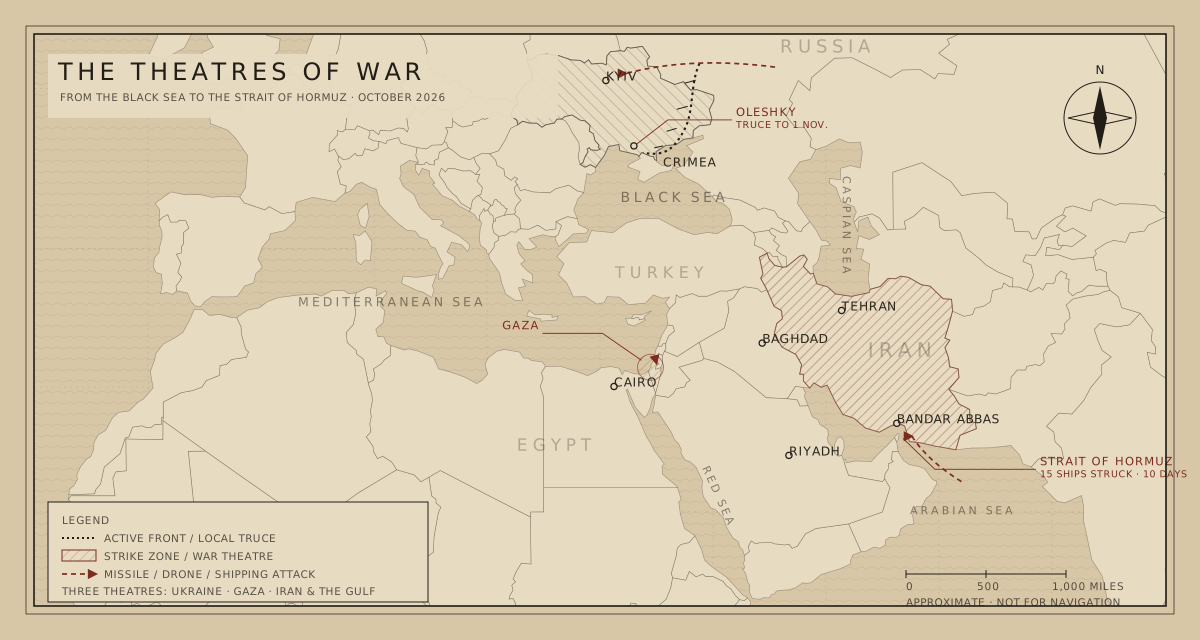
Three theatres, one conflict

From the Black Sea to the Strait of Hormuz, the wars feed one another: weapons, oil, bases, mediation and grief.

Stylized war map from the Black Sea to the Strait of Hormuz. Ukraine is shaded and marked by a dotted front line; Gaza is circled on the eastern Mediterranean; Iran is shaded red; the Strait of Hormuz is marked at the mouth of the Persian Gulf.
Map: The World Ledger. Sources: Institute for the Study of War; UN OCHA; shipping and diplomatic reports. Not to exact scale.
1

Ukraine · Kherson

A truce in one city, war everywhere else

1,700–2,000 people remain trapped in Oleshky. The local ceasefire runs to 1 November; Russian strikes continue elsewhere.

2

Gaza · The Levant

74,564 dead. A truce in name.

1,565 people have been killed since the ceasefire began. Aid is being cut and famine risk is rising again.

3

Iran · The Gulf

Eight months. $47.1bn. A new offensive?

Washington has warned Gulf allies of a possible renewed attack after the midterms. Iran has rejected the latest mediation.

Rotogravure · The week in pictures

The human geometry of war

Three places. One week. The same arithmetic, repeated in different light.

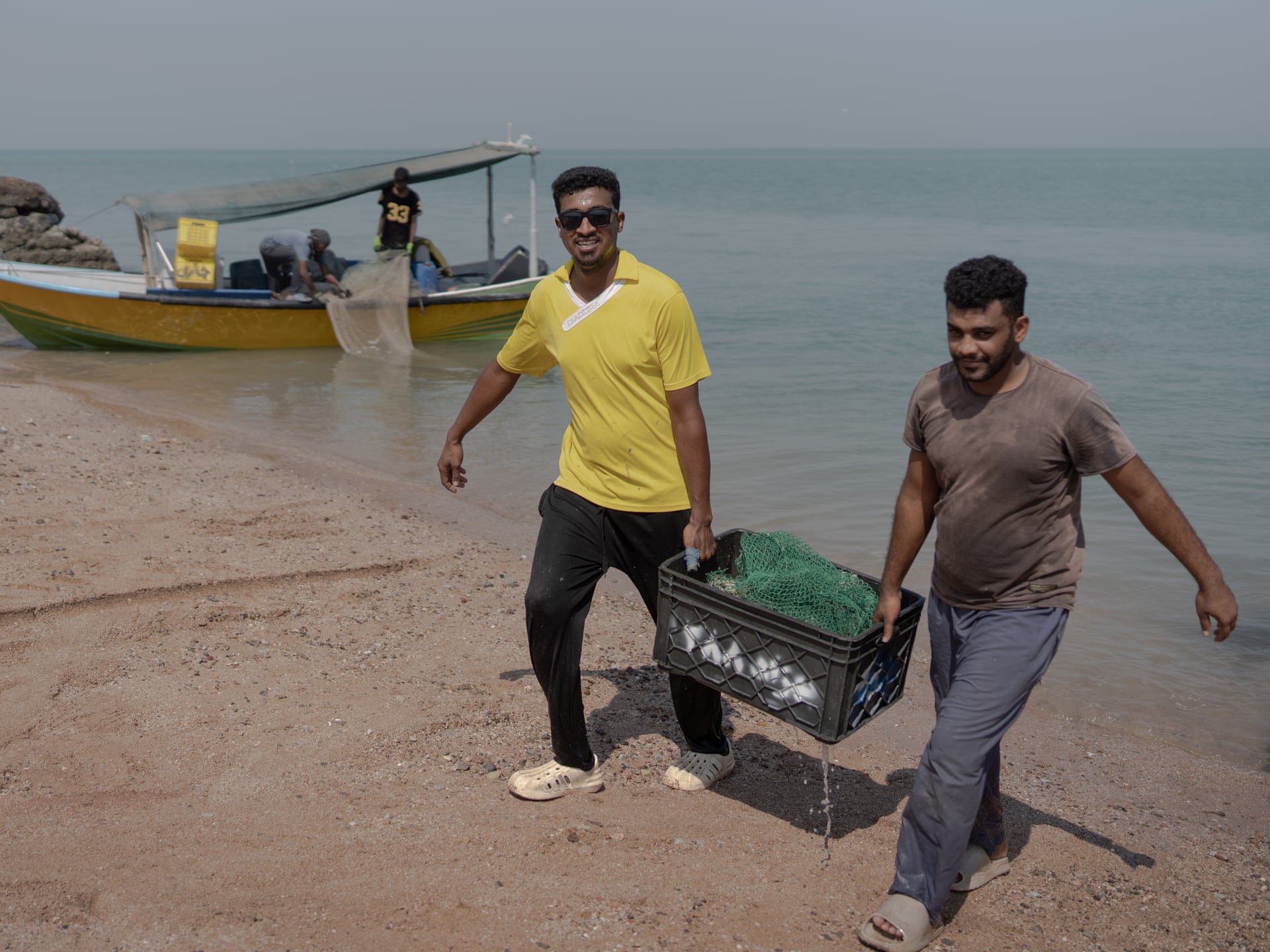
Two fishermen carry a crate of catch along a beach near Bandar Abbas, with a small boat behind them.
Bandar Abbas, Iran

The sea is still worked

Fishermen return to the shore on the Strait of Hormuz. The waterway is both a lifeline and a target: at least 15 vessels have been struck in ten days.

Mohammad Mohsenifar / The Guardian
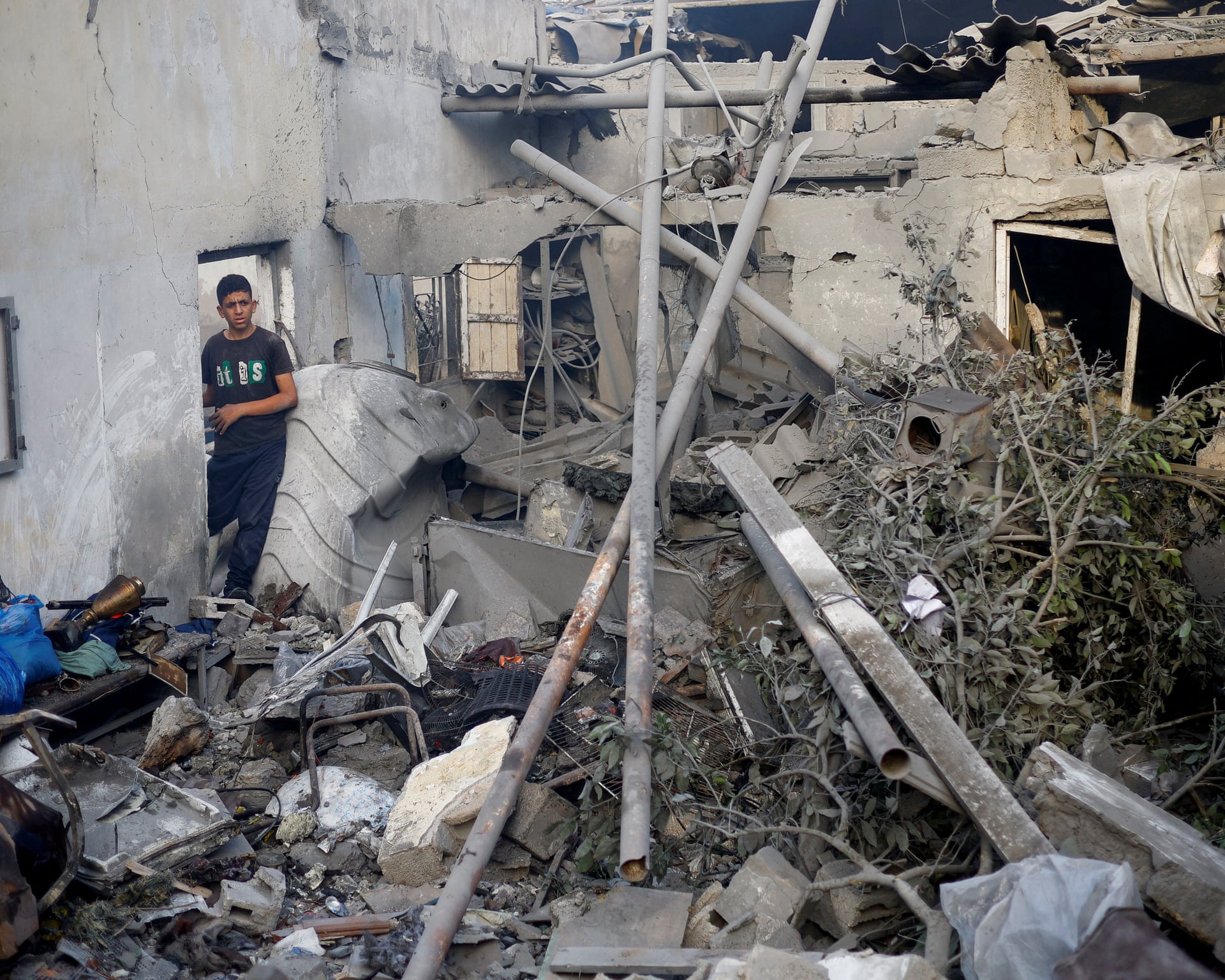
A Palestinian boy stands in the ruins of a destroyed house in Gaza.
Gaza

The walk home

A boy stands amid the rubble of a house destroyed by an Israeli airstrike. The health ministry says 74,564 people have been killed since October 2023.

Mahmoud Issa / Reuters
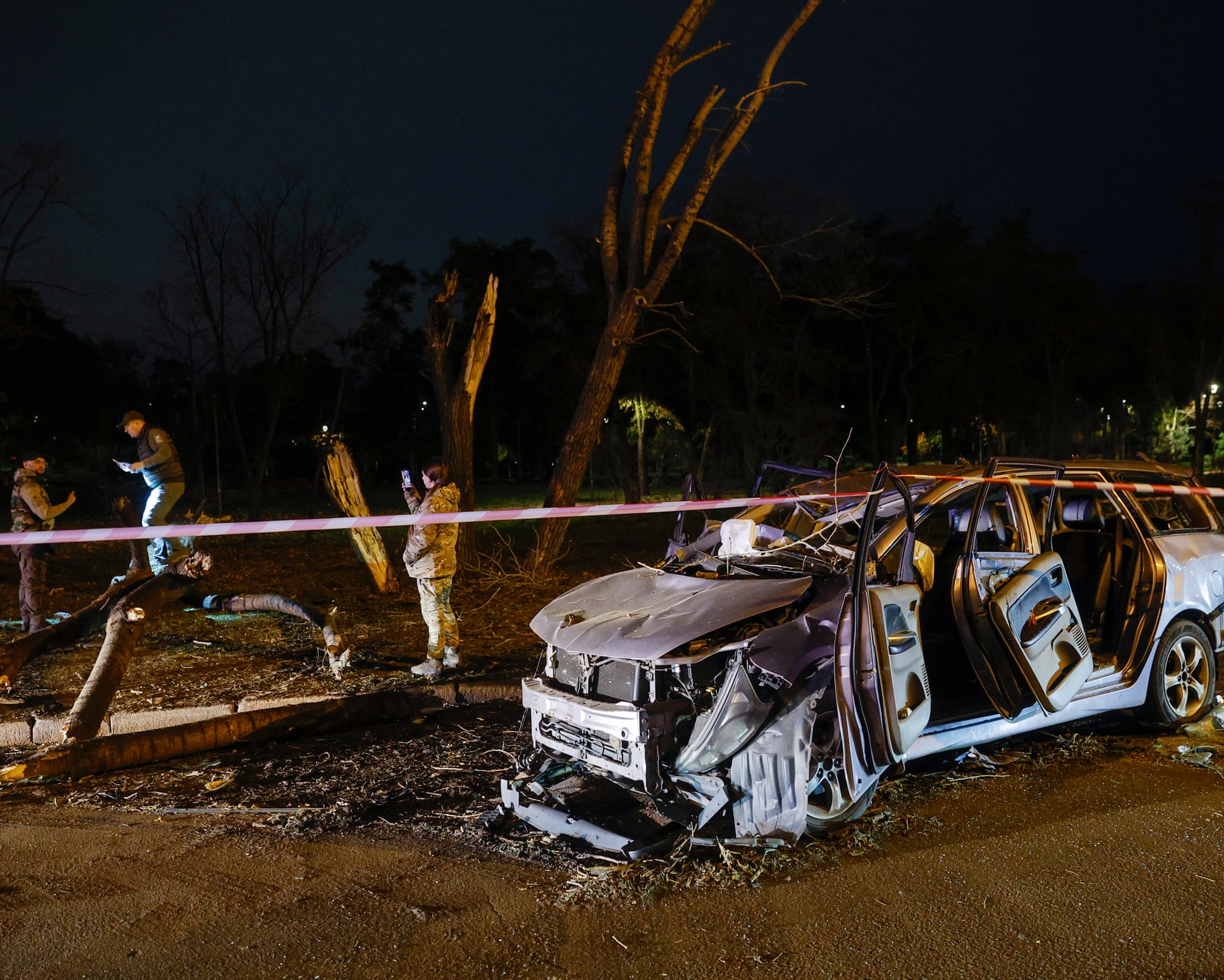
Investigators inspect a wrecked car at night at the site of a Russian missile strike in Kyiv.
Kyiv, Ukraine

After the missiles

Investigators at the scene of a Russian missile strike on 27 October, hours before the Kherson truce took effect.

Sergey Dolzhenko / EPA

From the night desk

Dispatches in brief

The stories that do not fit above the fold, but do not go away.

Washington

Iran war casualty count revised — again

The Pentagon lowered its count of Americans killed and wounded in the Iran war this week, prompting questions from lawmakers. The official toll had been 21 killed and more than 800 wounded.

ABC News

Gaza

Half a million lose WFP support

The World Food Programme is ending support for 500,000 Palestinians in Gaza because of funding cuts, as flour shortages close bakeries and prices rise.

The Guardian · WFP

Hebron

Nearly 2,000 displaced as Israel seizes homes

Israeli forces took over homes in Hebron after two soldiers were killed, displacing nearly 2,000 Palestinians. Netanyahu vowed to “destroy this place”.

The Guardian

Moscow

13 years for a donation to Ukraine

A Russian IT worker was sentenced to 13 years in prison for donating money to Ukraine, Al Jazeera reported.

Al Jazeera

Kyiv

Missiles fall hours before the truce

Russia struck Kyiv with ballistic missiles hours before the Kherson ceasefire began. Zelensky said the strikes hit crowded areas with no military facilities nearby.

The Guardian

Tehran

Jafar Panahi sentenced again

The Iranian filmmaker has been given a new prison sentence, with the charges unclear, after returning to Iran despite an earlier conviction.

The Guardian

Aden

Houthi missile kills five at presidential palace

The attack on Aden’s Al-Maashiq palace was the first in the latest round of fighting between the Iran-aligned Houthis and Saudi Arabia.

The Guardian